
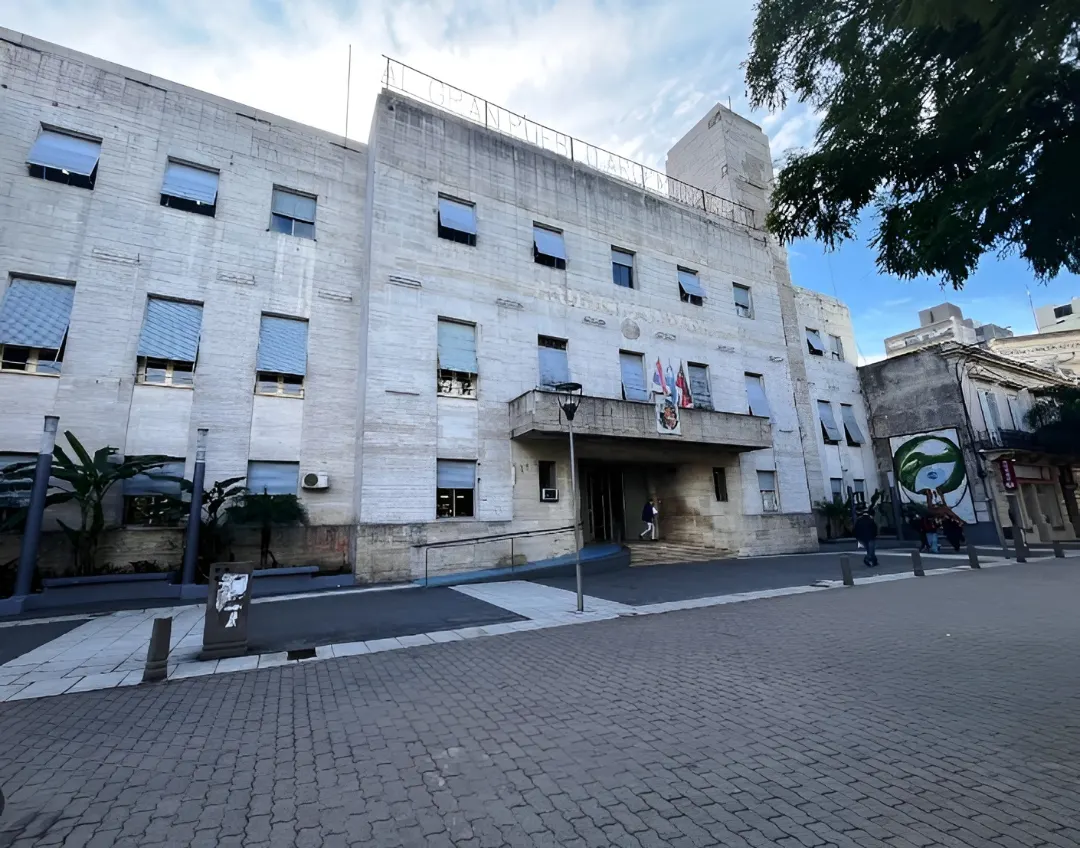
In the framework of World Agriculture Day, this Monday morning, Mayor Francisco Azcué led a working meeting of the Municipal Agroecological Advisory Council.
The meeting was attended by the Director of Cooperativism and Associativism, Ariel Gorostegui, along with representatives from the institutions that make up the space, such as the National Institute of Agricultural Technology (INTA) or the National Institute of Industrial Technology (INTI). On this occasion, local producers also joined in to discuss their trajectory, needs, and objectives.
Azcué explained that it was “a day we set aside to advance very important projects that have been underway for some time; one of them is the Participatory Guarantee System, which is a seal focused on agroecological production and organic products generated here in our city by local producers.”
The mayor stated that “we are truly very interested in this project continuing to advance, first because there are many institutions involved and the municipality, through the Secretariat of Productive Development; and of course, supporting the producers who are men and women of this city who work the land, who generate these products with great environmental awareness and with great respect for the environment.”
In Concordia, there are currently five producers who hold the municipal seal for agroecological products. There are two in the process of obtaining it and three interested in obtaining it.
MORE PRODUCTION
Jorge Andrés, from the local INTI Extension Unit, commented that one of the Council's objectives is “to continue expanding that number of producers because this is a process that has been going on for many years of work and formally began in 2018.”
In addition, he detailed that the promotion of agroecology in Concordia brings together, in addition to INTA and INTI, the National University of Entre Ríos (UNER) with the Faculty of Food Sciences, the UTN, and the Provincial Institute of Food Control and Bromatology; among others.”
Andrés concluded by highlighting that the articulated effort is taking place “in pursuit of a concrete objective, which is to produce healthy food.” In a context “like the one we are going through, it is central that the municipality can support this process so that we help the residents of Concordia access quality and healthy food,” he concluded.
MEMBERS
The Municipal Agroecological Advisory Council is made up of several key institutions in the development of agroecology in the region, such as:
Family Farming
CONICET (National Scientific and Technical Research Council)
INTA (National Institute of Agricultural Technology)
UTN (National Technological University)
CAFESG (Administrative Commission for the Special Fund of Salto Grande)
ICAB (Institute of Food Control and Bromatology)
INTI (National Institute of Industrial Technology)
Faculty of Food Sciences
SENASA (National Food Safety and Quality Service)
Local producers
OBJECTIVES
The main purpose of the Council is to provide a quality seal to agroecological production, which encourages the consumption of healthy food and ensures the safety of the products that reach consumers. During the meeting, the importance of family farming as a productive model was highlighted, which not only promotes healthier eating but also protects natural resources and supports local economic development.
Agroecological family farming seeks to generate sustainable production systems through the rational use of resources and respect for natural cycles, providing fresh and safe products for the community.
WHAT ARE PARTICIPATORY GUARANTEE SYSTEMS (PGS)?
Participatory Guarantee Systems emerged in the early 2000s as a key tool for agroecological certification. Unlike traditional certification systems, PGS promote a participatory process that involves producers, consumers, and other local actors in the verification of production practices and the application of agroecological principles.
The main objective of these systems is to guarantee the quality and safety of food, ensuring that products meet agroecological standards without depending on external certifiers. In this process, the same actors involved in the production chain are responsible for validating that the practices are correct, fostering a more direct and reliable link between the producer and the consumer.