
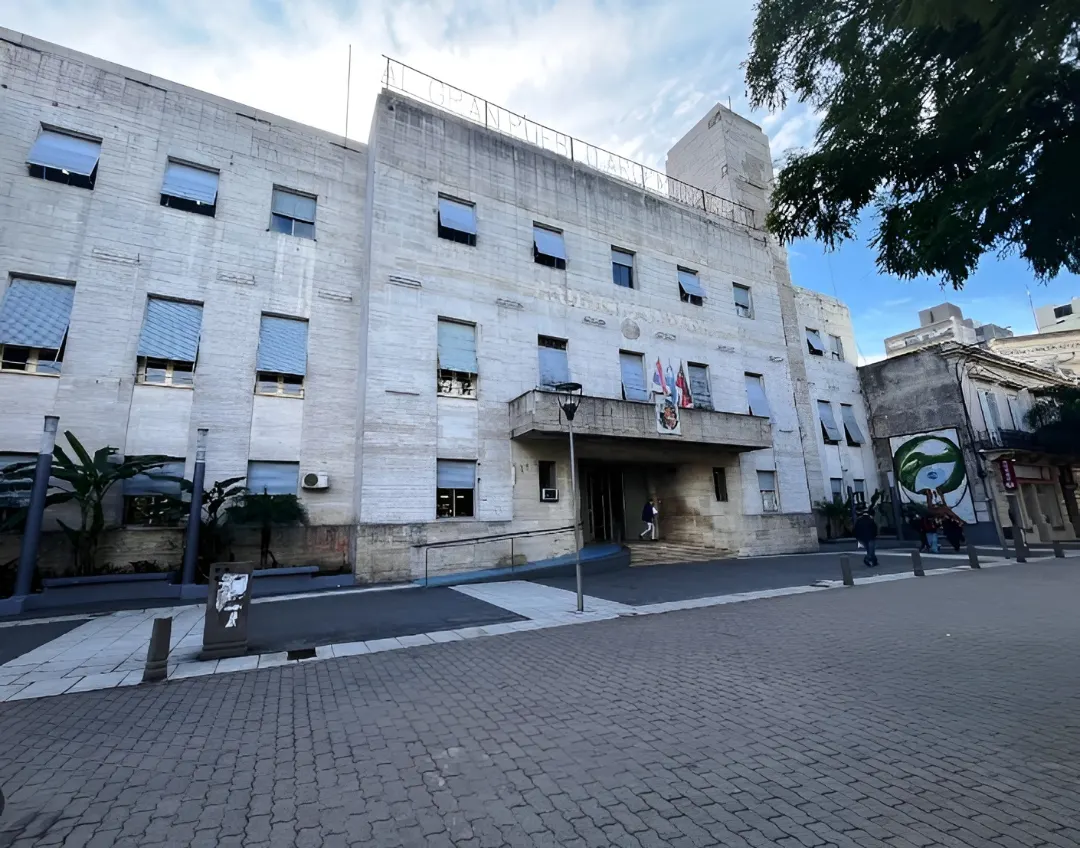
Mayor Francisco Azcué, together with the Secretary of Government, Luciano Dell´Olio, presided over a key meeting with council members of the Deliberative Council, members of the Knowledge Economy Advisory Council, and municipal officials. “Concordia has everything necessary to be a hub for the knowledge economy: professional training and talent,” stated Azcué.
The main objective was to debate the Provincial Knowledge Economy Law No. 10.895 and its Amendment No. 11152, and to analyze the regulation of a local ordinance that promotes the adherence of companies in the sector to this law.
During the meeting, crucial topics for entrepreneurs and business owners in the technology industry were raised, highlighting the need for a regulatory framework that incentivizes the growth of these companies and fosters their consolidation in Concordia.
Before this meeting, Mayor Azcué held a private meeting with Blas Briceño, CEO and Founder of Finnegans, a software development company specialized in business management. Briceño, in addition to being a benchmark in the technology industry, is a member of the Argentine Chamber of the Software Industry and a strategic ally for technological development in the city. During the pandemic, Briceño installed a Finnegans branch in Concordia, creating more than 60 jobs for local youth, whom he considers "indispensable talent for the growth and productivity" of his company.
THE IMPORTANCE OF REGULATION
The knowledge economy encompasses activities such as software development, biotechnology, nanotechnology, audiovisual services, and research and development (R&D). It is a constantly growing sector, with high demand for specialized profiles and globally competitive salaries. In Concordia, the Municipality works together with universities, NGOs, business owners, and civil society to generate an ecosystem that offers opportunities within this sector.
Mayor Azcué stressed that "Concordia has everything necessary to be a hub for the knowledge economy: professional training and local talent." At the same time, he reaffirmed the Municipality's commitment to continue promoting spaces for exchange that foster job opportunities for young people.
THE CHALLENGE OF 1000 JOBS IN THE KNOWLEDGE ECONOMY
Among the points debated in the meeting, the following stood out: adherence to the Provincial Knowledge Economy Law, the creation of the Municipal Registry of Companies in the sector, benefits in municipal taxes, priority use of innovation spaces, employability policies, local financing, advice for project formulation, and the active participation of companies in the Advisory Council.
The Municipal Director of Revenue, Accountant Fernando Marsicano, emphasized the need to "generate policies that incentivize the establishment of companies in this sector and analyze the possibility of exemptions in municipal taxes to encourage production."
For his part, Blas Briceño stated: "We are very aligned; what was once a dream is today a reality. Now we must go for new challenges." The Undersecretary of the Special Unit for Strategic Projects, Licentiate Leandro Garbarino, added that "these initiatives are key to continuing to generate more job opportunities for young people."
Finally, the Coordinator of the Knowledge Economy Advisory Council, Licentiate Ivonne Saleh, expressed with enthusiasm: "These actions are fundamental for the growth of Concordia, and the regulation of this ordinance will mark a turning point for the companies and actors involved in the local technology industry."
Among those present who supported this initiative were the Secretary of Productive Development, Eng. Federico Schattenhofer; the Director of Strategic Planning and Financing, Eng. Ignacio Terenzano; the Director of Innovation and Knowledge Economy, Licentiate Pedro Kohn; representatives of the Municipality's Employment Directorate; business owners from the technology sector; Deliberative Council members; the Secretary of Culture and University Extension of the National Technological University, Eng. Carlos Blanc; and members of the Knowledge Economy Advisory Council.