
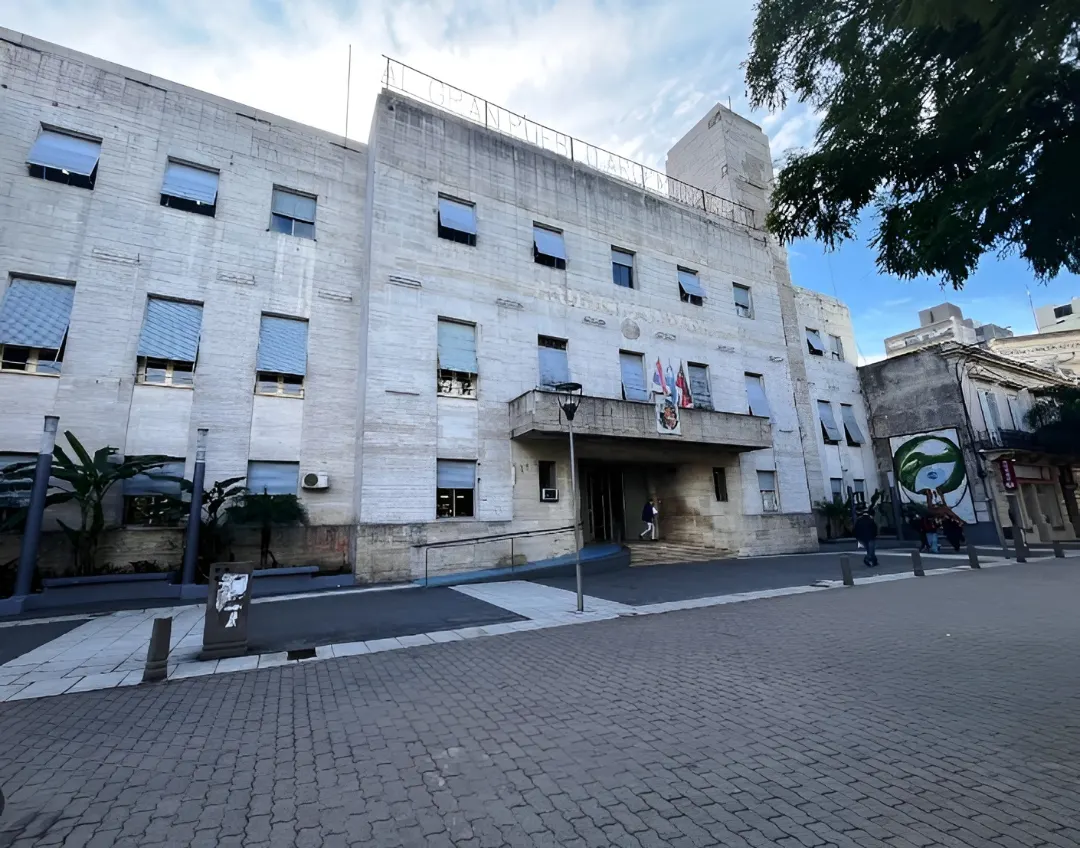
During this Friday noon, Mayor Francisco Azcué received a report regarding the impact of the construction of more than 130 houses through the NGO TECHO in the city, following an agreement between the Municipality of Concordia, the Government of the Province of Entre Ríos, and the aforementioned social organization.
At the local level, 131 emergency homes were built in the José Hernández, La Roca, and 27 de Noviembre neighborhoods during the months of November and December of last year.
With the project, quick and effective responses were provided to families living in emergency housing situations, improving their living conditions.
During the meeting, an analysis of the management and the socio-housing impact of the project was presented, in both its quantitative and qualitative aspects.
Said report was carried out by a research team belonging to the National University of San Martín, composed of anthropologists Máximo Badaró, Lucía de Abrantes, and Yanina Faccio.
In addition to Mayor Azcué, the Secretary of Cabinet Coordination and Treasury Pablo Ferreyra, the Secretary of Human Development Sebastián Arístide, the president of the Municipal Autonomous Housing and Land Institute (InVyTAM) Giuliano Rossi, and councilwoman Eliana Lagraña, among others, were present.
PUBLIC POLICIES AND OWN DATA
After the report was finished, Mayor Azcué highlighted the importance of having the material and the data it contains, under the current administration's premise that it is “impossible to transform what is not known.” Especially because the qualitative and quantitative axes are specific to Concordia and reveal an updated panorama upon which to design comprehensive public policies adapted to the local reality.
For her part, Faccio commented that during the months the measurement lasted, “we were able to tour the neighborhoods, talk to the families who were going to receive the houses; it was a process-based study, in three stages, since we came before the constructions to see how the land was being prepared, during the construction, and finally when they were finished.”
De Abrantes explained that in the research team “we are anthropologists and what we do is work with the data we build by being with the families, participating in their activities, and asking questions. We believe they are very valuable data to evaluate, analyze, and project far-reaching public policies.”
The professional also highlighted the concern of the “municipality of Concordia, which is very interesting because we have also been working in other cities in Argentina with different urban problems, and what is happening here, for example with the Relevar project, is the idea of building our own data, that the State knocks on the door and, starting from that, generates statistics that help the residents of vulnerable areas.”
Regarding future common challenges, Badaró explained that “we are available to continue this conversation that we started with the municipality, and now we have been summoned by the Secretariat of Human Development to conduct a study on the operation and an evaluation of the Relevar project, which for us is a continuation of what we have been doing for the TECHO event.”
In that regard, he stressed that “it is exceptional that a municipality places so much trust in the production of its own data and is constantly evaluating its public policy, producing information, managing, and once a policy is implemented, evaluating it and having a process of internal reflexivity.”
VALUABLE INFORMATION
Lucia Groos, director of the TECHO Center for Social Research and Innovation, commented that “from the University, they brought very valuable information, especially regarding the perception of the people who live in popular neighborhoods and how the entire work process we carried out was experienced.”
These are “very important data to continue improving the impact on families, which is what brings us together today to continue working together.”
Finally, Camila Zanoni, Director of Communication for the organization TECHO, pointed out that the project is not just about building houses: “The solution will never be just one thing when problems have so many dimensions, but it is always good to think of a starting point from where to begin. That comprehensive approach is fundamental, especially articulating it with all parts of the municipality to enhance the impact in every way possible.”