
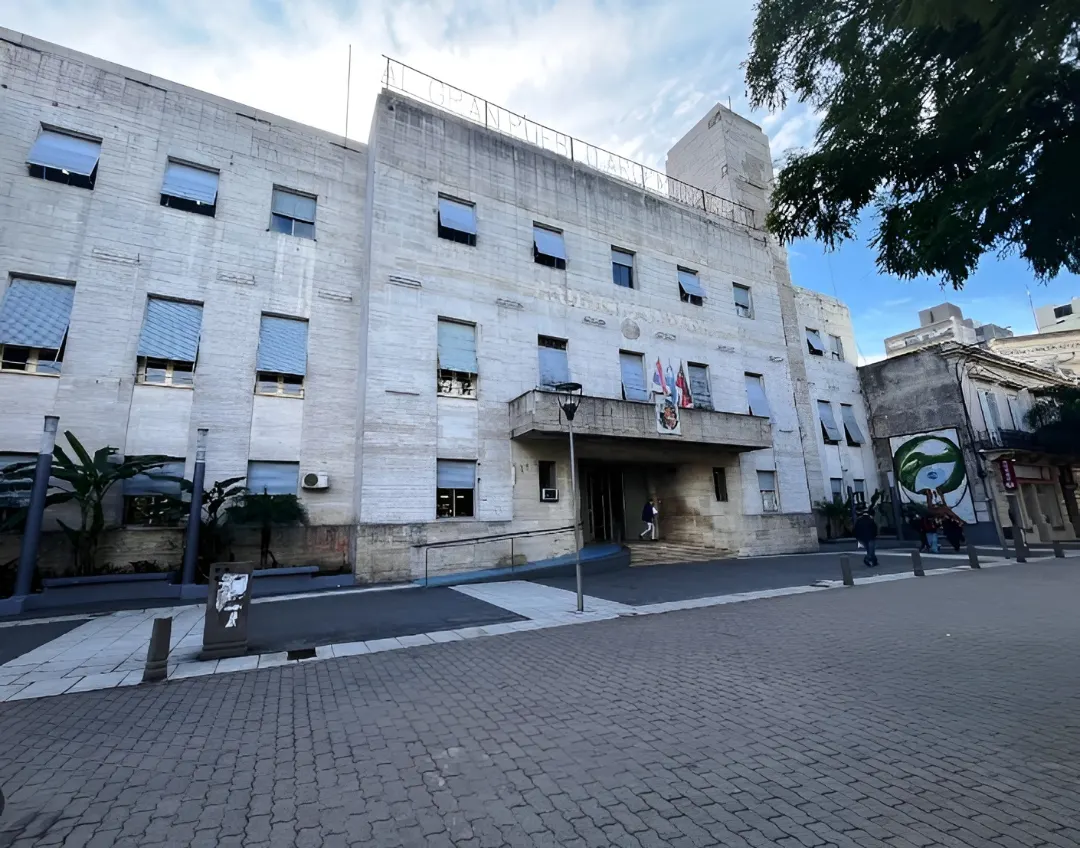
With a strong speech focused on lifting Concordia out of poverty, putting an end to policies that have been detrimental to the community, Francisco Azcué assumed the mayoralty of the city, accompanied by the Provincial Governor Rogelio Frigerio, Vice Governor Alicia Aluani, Vice Mayor Magdalena Reta de Urquiza, council members, and the cabinet.
The Mayor began by remarking that "it is an honor and an enormous responsibility to assume the municipal government of the city where I was born, that of my grandparents, my parents, and the one I chose to raise my children in," adding that it is "the most important challenge of my life, and I am here by the choice of my residents, at a very particular moment, who trusted in a proposal that combines sensitivity and responsibility. I am part of a project that has the province as its north, and where Concordia is of vital importance, led by our leader and guide, Governor Rogelio Frigerio."
Azcué stated that Concordia has gone "in the last 40 years, from being a destination of hope, a thriving city, and a land of progress, to being one of the cities that leads poverty indices. It is very sad. It is not a cyclical problem that can be solved with one measure" because it "has conditioned the development of people and placed limits on the possibilities of economic growth."
WORK, EFFORT, AND MERIT
To get out of this situation, Azcué stressed that in his administration "we are going to bet on the culture of work, effort, and merit. We are going to work to create favorable conditions for production and development; for investment and productive, economic, and financial growth. We are clear about our role and what the role of the private sector is," emphasizing that "we are not partners of the private sector, but we are going to support them so that they choose our city," highlighting that the role of institutions and social organizations will be fundamental when working on policies that allow for the transformation of Concordia.
"We are taking office in a Municipality that is not only in debt but also going through a tragic social situation," which shows that debt is harmful "and poor administration generates a profound deterioration of the social fabric. The system of paternalism and control that has made the State a manager of poverty must be abandoned. We are going to end welfare policies, the cult of emergency, and we are going to bring about a State that provides tools so that people are part of the system, develop, and grow."
END PRIVILEGES
The Mayor specified that "we are going to work with an austere and strict budget, removing every procedure that constitutes an obstacle or an incentive for corruption," adding that "unnecessary expenses and political privileges are coming to an end; the payment of cell phone bills and the use of official vehicles for personal use are coming to an end," asking officials from the previous administration who have not yet handed over "the assets that belong to the Municipality, to do so within the next 24 hours."
"We are going to take care of the State's resources. If we do not gradually resolve the enormous social and economic debt, governability will increasingly be a chimera. No one wants to live in a city split in two," which is why "I ask you from the heart to work with generosity, with a vocation for service, and that we take care of the important things: productive development, human development, and restoring order."
He also referred to the growth of drug trafficking in the city and, addressing Governor Frigerio and the Minister of Security and Justice Néstor Roncaglia, Azcué remarked that "here you have a soldier to fight that battle to combat mafias and drugs in the city."
Finally, he pointed out that "what is to come requires dialogue and consensus," and for that "we have to end the divide. Societies that understand that the path is dialogue, construction, and consensus will be successful," and those that continue on a different path "will not get anywhere. Today history challenges us, and what is important is to work for our country, for our province, and for Concordia to move forward. It is a cause that unites all generations. It is not about one day, but about going step by step, learning, and never losing that stimulating horizon that we can and must be better."
A NEW STAGE
For his part, the Governor, Rogelio Frigerio, expressed that "Francisco has an enormous challenge, and I firmly believe in political alternation because it is a very important factor of democracy." Likewise, he highlighted the trust placed in him: "I know he is a good person, I know he is a person who loves his people, I know he is a person who has also prepared himself for this historic moment he has to face, and I am sure he will not betray the trust of the residents."
"We want a new stage to begin in our province; people voted for change at the national level and also in Entre Ríos, and we have to pick up the gauntlet, as I stated yesterday in the inaugural speech, we have to listen to the people because they want something else from politics," emphasized Frigerio.
CABINET
After having been sworn in as mayor, Azcué proceeded to do the same with the cabinet, from whom he requested "conduct, honesty, and humility." It was formed as follows:
Eduardo Caminal, Chief of Cabinet
Luciano Dell’Olio, Secretary of Government and Treasury
Osvaldo Pérez Hatoum, Secretary of Urban Development
Sebastián Aristides, Secretary of Human Development
Federico Schattenhofer, Secretary of Productive Development
Cristian Federik, Secretary of Institutional Development
Lorena Aguilar, General Secretary of the Mayor's Office
ATTENDEES
Present were the Minister of Government and Labor Manuel Troncoso; of Security and Justice Néstor Roncaglia; National Deputy Atilio Benedetti; Provincial Deputies Carola Lanera and Marcelo López; Mayors of the region; representatives of the Armed Forces and Security forces; of civil and social organizations and institutions of the city, and the general public.