
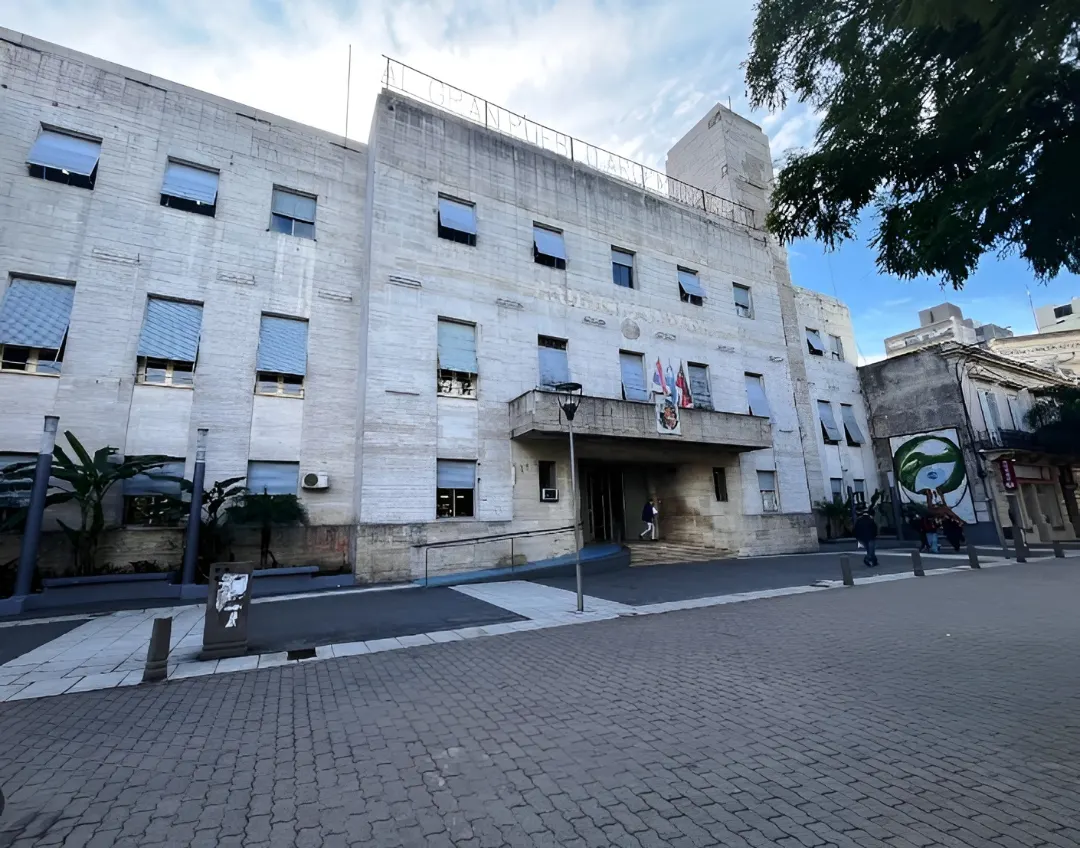
“We must continue deregulating, eliminating obstacles, bureaucracy, and taxes, and create conditions for the private sector to generate profitability and choose us. We are a government that has the idea of turning politics into facilitators,” remarked the Mayor of Concordia.
During this morning, Mayor Francisco Azcué performed the opening of the XII Conference on Financing for Productive and Industrial Development, organized by the Directorate of Industry and Industrial Parks, under the Secretariat of Industry, Commerce and Mining of the Province of Entre Ríos and the Secretariat of Productive Development of the Municipality of Concordia.
This training marks the beginning of the 2025 cycle, with a focus on the Incentive Regime for New Investments (RINI).
During the conference, financing and guarantee tools available from both the provincial sphere and private entities, especially oriented towards the industrial, tourism, transport, and cultural sectors, were presented.
In addition to the Mayor of Concordia, the event was attended by the General Director of Industry and Industrial Parks of the Ministry of Economic Development of Entre Ríos, María Cecilia Lacava; the local Secretary of Productive Development, Federico Schattenhofer; and the Executive Coordinator of the Provincial Executing Unit, Hernán Marcó, among other officials and representatives of the private sector.
GENERATING CONDITIONS
Azcué greeted those present and remarked that “we are part of a political and management project that is governing the province and many localities, led by Governor Rogelio Frigerio, and he has given us a clear instruction, which is to work in an articulated manner to generate conditions that allow our province, and in this case our city, to return to being a land of opportunities.”
From the first stage of the administration, the mayor of Concordia recalled that the challenge was “to generate that favorable ecosystem so that people, from outside or the residents of Concordia themselves, decide to take risks, invest, and develop projects in our city.”
“Throughout this time we have managed to bring order to the province, and in this case in Concordia we were able to do so with the administration, reducing the tax burden, eliminating municipal taxes—more than 300—and deregulating and eliminating procedures,” remarked Azcué.
In that sense, he highlighted that “this is a process that has begun and will not stop while we are in office. We must continue deregulating, eliminating obstacles, bureaucracy, and taxes, and create conditions for the private sector to generate profitability and for them to choose us.”
To those present, the mayor of Concordia reminded them that “you have a government with the idea of turning politics into facilitators: we move away from the center of the scene and you are the engine of growth and development.”
INVESTMENTS AND EMPLOYMENT
In his turn, Schattenhofer expressed his satisfaction with this new Conference that allowed “showing all the financing alternatives to the true interested parties, who are our business owners and entrepreneurs,” maintaining that one of the objectives is to be able to concretize investments in Concordia in “two sectors very strongly rooted and established, such as the forest-industrial sector and tourism.”
Always with the aim that they “generate work and foster employment,” he announced that shortly, the Deliberative Council will adhere to the investment regimes promoted by the Nation and the Province.
DEVELOPMENT AND SUSTAINABILITY
For her part, Lacava recalled that “last year we presented the Investment Promotion Regime for Industrial Development and this year we come with the RINI, which expands the benefits to other sectors such as tourism, transport, and culture; with a special focus on circular economy and reduction of the carbon footprint.”
Currently, the pre-registration for the RINI is open. “We already have seven pre-registered, six are admitted with a significant investment and a generation of 170 jobs; and this is only in one month,” she detailed.
The representative of the Ministry of Economic Development of Entre Ríos pointed out that “the sectors that are applying today are transport, circular economy, and industry, but we are missing tourism, and we understand that Concordia is a neuralgic and key tourist center of the province,” concluded Lacava.