
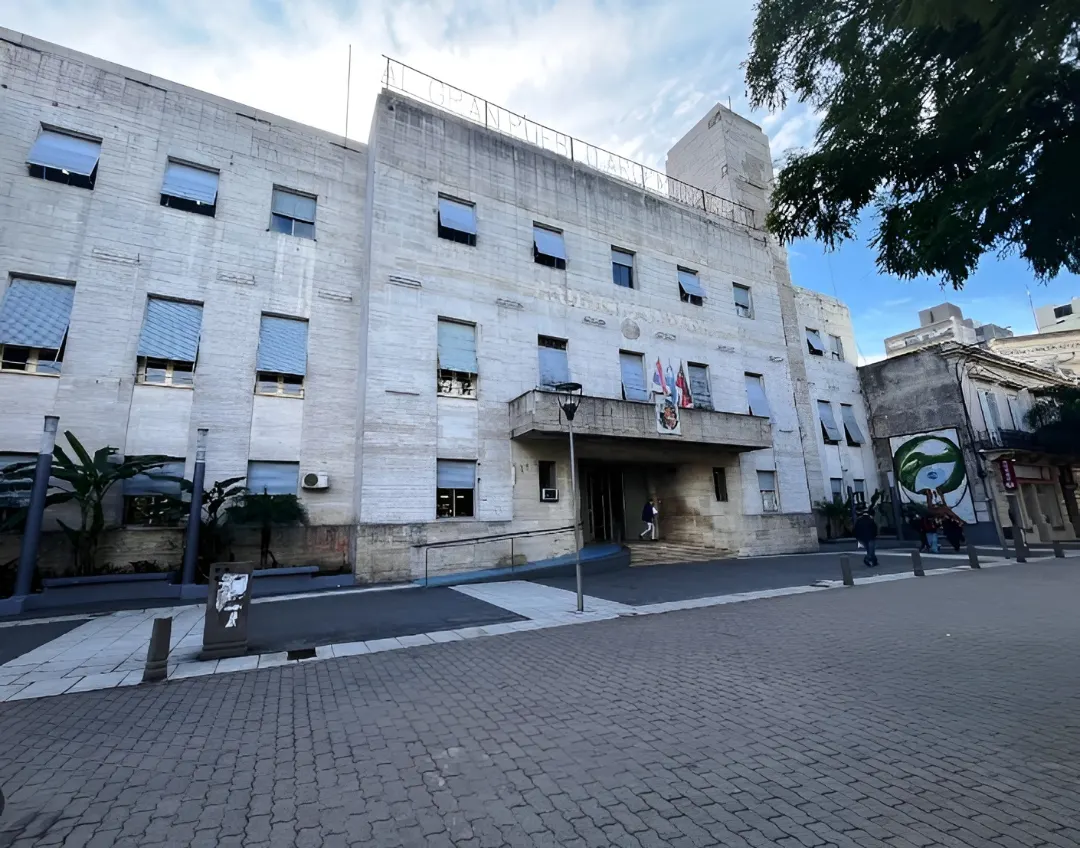
The objective of this is to begin developing joint actions between the Municipality of Concordia and intermediate institutions or organizations in our city based on the information gathered through the “Relevar” Project and as established in the July Pact. “In our administration, families are not numbers; for us, they have a first and last name, a reality, a history,” remarked the Mayor.
During this Monday morning, Mayor Francisco Azcué led the launch of the Local Human Development Board, which was established by Ordinance as a space for coordination and articulation of national, provincial, and municipal public policies for a comprehensive approach, with the aim of prioritizing the improvement of the expansion of people's options and capabilities, guaranteeing their rights, to achieve an improvement in life expectancy and access to the resources necessary for a dignified standard of living, reducing the degrees of social, territorial, and gender inequality.
To this end, planned work with clear goals is established, through the execution of concrete actions that allow for the solution of short, medium, and long-term problems, taking into account the local reality and the particularities of each specific case, implementing the formulation of educational, sports, cultural, and food policies; articulating with civil society actors and promoting the strengthening of the social fabric. The Local Board will operate under the orbit of the Secretariat of Human Development.
WITH FIRST AND LAST NAME
“This is part of what we have committed to through the signing of the July Pact as well as when we presented our government plan, which is the articulated work with intermediate institutions,” affirmed Azcué, while adding that throughout this 2024 the “Relevar” Project has been carried out, with which “we were reaching different neighborhoods, gathering more than important information from families who are not numbers; for us, they have a first and last name, a reality, a history.”
So that the results are more effective when carrying out the approaches that each situation demands, “we need more tools and to work in an articulated manner with intermediate institutions, clubs, churches, foundations, NGOs, in a network. We know that some of them are already doing so, in an isolated manner, which is why the idea now is to do it jointly.”
JOINT WORK
Sebastián Arístide, Secretary of Urban Development, recalled that throughout this year work has been carried out in the field with the “Relevar” Project, touring the neighborhoods, understanding what is happening “and trying to solve each problem we encounter, identifying the families, and as we were advancing, we discovered that there were situations that the Municipality could address but that there are also complex problems that are intertwined, and it was necessary to begin involving public, private, and intermediate institutions.”
If a space and joint work are not generated, “we will not be able to provide the forceful responses that the resident expects. Today we are here to offer an open space from the municipality so that all people and institutions that want to collaborate and participate in organizing those responses can join,” stated Arístide.
THE FAMILY AS A CORE OF DEVELOPMENT
Finally, Councilwoman Eliana Lagraña, author of the Ordinance that established the creation of the Local Human Development Board, recalled that it arises from joint work with the Secretariat of Human Development, within the framework of the July Pact, and that it was approved unanimously in the Deliberative Council.
“This is born as a need to establish a superior proposal regarding an ordinance that was already in force, which was a local board for early childhood, but we believe that emphasis must be placed on what the family nucleus is, not only on children but on the environment in which they develop.”
FORMATION
It is established that the Local Human Development Board will be formed and will have permanent representation from the different Undersecretariats that make up the Secretariat of Human Development; other Secretariats of the Municipality of Concordia; the Civil Registry and Capacity of Persons, Concordia Delegation; ANSES, Concordia Delegation; the Provincial Council for Children, Adolescents and the Family (COPNAF); the Felipe Heras, Delicia Concepción Masvernat, and Ramón Carrillo Hospitals; the Departmental Directorate of Schools; the Judiciary; the Police of Entre Ríos; School Canteens; Religious Institutions, and one representative from each bloc of the Deliberative Council.
Accompanying the launch were Provincial Senator Cielo Espejo and Provincial Deputy Marcelo López.