
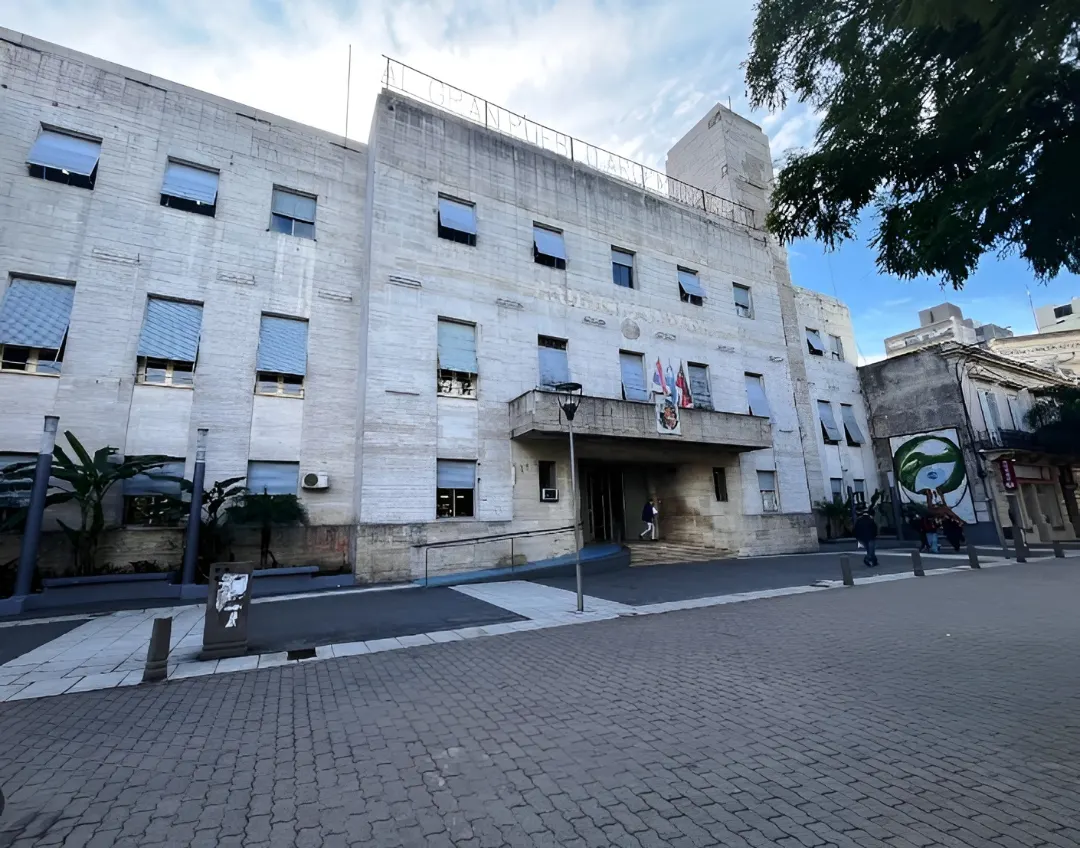
During this Wednesday morning, Mayor Francisco Azcué toured the progress of the Knowledge Node project, which is being carried out at the Costanera. It is an innovative space for foreign, national, or Concordia-based companies in the technology sector to establish themselves in the city and hire local talent.
The Knowledge Node will feature a training center and private offices for companies, allowing for a more versatile and attractive work environment.
The goal is to showcase the Concordia lifestyle as a valuable asset to attract companies and talent. It is designed with resilient infrastructure against flooding. To protect it from potential weather events, the infrastructure is designed to exceed the 17-meter level.
It features overhead electrical installations and windows that can be removed and closed to prevent damage. Additionally, it uses washable materials and paints to facilitate cleaning, eliminating the use of drywall. This minimizes issues and facilitates maintenance.
The tour was attended by the Undersecretary of the Special Unit for Strategic Projects (UEPE) Leandro Garbarino; the Director of Innovation and Knowledge Economy (DIEC) Pedro Kohn; and María Perini, head of the Costanera Entity.
KNOWLEDGE AND DEVELOPMENT
During his tour, Mayor Azcué, who had announced this project during the opening of the Ordinary Sessions of the Deliberative Council as one of the actions to be completed in 2025, stated that it is “one more step on the path of development and the transformation process of Concordia,” recalling that the first step was “to advance an ordinance establishing that all Knowledge Economy companies that settle and develop a project will not be charged municipal taxes for 10 years”.
Azcué affirmed that the knowledge sector “is an industry that provides high-quality employment sources, and we have enormous potential”.
Regarding the location of the Node, the Mayor indicated that “we are going to recover this place, which belongs to all residents of Concordia, for matters related to the productive, commercial, and tourist development of our city”.
INNOVATION ECOSYSTEM
Kohn recalled that the project “arises thanks to a National Plan through which cities were sought to have a space that brings together and groups the entire innovation ecosystem, and that is what we are doing here”.
Regarding its functionality, he explained that it is “a co-working space, similar to the one we have at the Convention Center, but with more capacity,” adding that the site will allow for the installation of at least 3 companies with up to 30 people each. “This is a first stage; there is much room to grow afterwards”.
For his part, Garbarino recalled that during 2024, “more than 1,500 residents of Concordia participated in training” related to the Knowledge Economy, seeking to generate job sources. “We want to reach one thousand jobs; today we are at around 300, but that is the great goal for our city”.
According to the established deadlines, the Knowledge Node is expected to be operational within the next 45 to 60 days.