
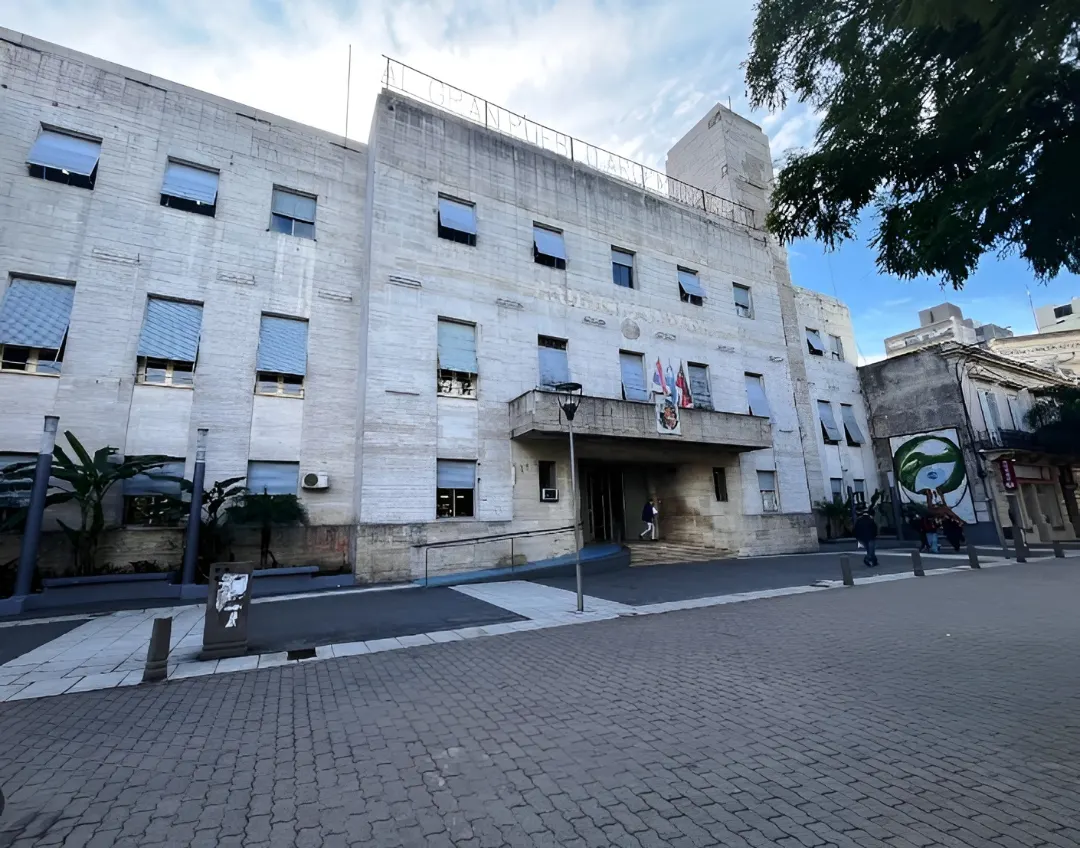
This Friday, together with institutions and residents, Mayor Enrique Cresto and the Undersecretary of Federal Articulation of the National Ministry of Health, Verónica De Cristófaro, shared the inauguration of the Decentralization and Network Care Node in Villa Adela. Provincial and local officials, council members, neighborhood representatives, and health sector leaders participated in this inaugural day.
The project was managed and promoted by the municipality in coordination with the National Government - through the Ministry of Public Works and the Ministry of Health - and the Provincial Government. The new multidisciplinary center will be used both to strengthen primary health care and for the decentralized operation of public agencies.
In this way, the Node - built through the National Program for the Strengthening of Health Infrastructure - will fulfill a strategic health and social function in Villa Adela, Las Tejas, El Martillo, Benito Legerén, and surrounding areas.
“To carry out this work, there were political decisions with a federal sense, teamwork, and citizen participation,” highlighted Cresto. “Our goal is to guarantee the presence of the State in every corner of the city,” he added.
“Now residents must value the dimension that this progress has for everyone and feel this space as their own, because it is a project that puts people at the center of public policies and is carried out within the framework of a collective process with an eye on the future of this entire area,” defined the Mayor.
In the same vein, Cresto valued the support and accompaniment “of the National Government, Minister Gabriel Katopodis, Minister Carla Vizzotti, the different teams that intervened in the project, and Governor Gustavo Bordet, with whom we share an agenda focused on the development and growth of Concordia,” he remarked.
Likewise, the Mayor highlighted “the importance of municipal health centers and the different spaces where work is done every day to provide solutions to people and strengthen the health system,” he indicated.
FEDERALISM AND TEAMWORK
From the national level, the Undersecretary of Territorial Articulation of the Ministry of Health, Verónica Cristofaro, highlighted “this federal proposal from a government that permanently looks at the interior of the country.”
The official indicated that there are 90 nodes like the one in Concordia being placed throughout the national territory. She spoke of the importance “of the reunion with the community after the pandemic” to deepen the care of the population; and valued the great health team that in Concordia “ensures the presence of the State in the neighborhoods.”
In this sense, Cristofaro pointed out that “the demographic growth of the city indicates that there are many people who decide to come to live in this productive town of Entre Ríos. Concordia is growing and I celebrate that its mayor has managed this new health location, mainly for what this space represents in the long term,” she affirmed.
For his part, the Municipal Secretary of Health, Mauro García, expressed that “today is an extremely happy day for those of us who work in health, due to the birth of this health center which is number 20 in Concordia,” he highlighted.
García thanked “our Mayor for making it possible, for having managed this work in the middle of the pandemic, when he was in charge of ENOHSA”; and marked the relevance in terms of health planning that the node will acquire: “In the southern area of the city we are providing the third territorial device, which is added to the health centers in Villa Adela itself and in Benito Legerén. This triangle that is formed with El Martillo will increase health coverage and municipal offices and agencies such as ANSES or PAMI will also operate there,” he anticipated.
From the Villa Adela Retirees Center, Lucía Lian pointed out: “This is a beauty, it is something that we must all take care of, because it is very necessary and it will change our lives.”
DECENTRALIZATION
The administration of Mayor Cresto promotes a municipal decentralization process, with the purpose of optimizing resources, providing faster solutions to citizens, and reducing bureaucracy for some procedures. The proposal consists of dividing the city into different zones, in each of which a delegation is to operate where the same procedures can be carried out as in the main building of the Municipality of Concordia. In this way, time and distances are saved. The first Municipal Delegation that was put into operation for this purpose was that of Villa Zorraquín, in 2018. With this type of action, a methodology was launched so that the different neighborhoods have greater prominence and can define their priorities. This process is now advancing with this new Node facility in Villa Adela.
WORKS COMPLETED
The inaugurated modular center has a covered area of 388 m2. It is a building built with dry construction, mounted on a reinforced concrete slab, which contains: reception and waiting hall, multipurpose room, administration office, restrooms for staff and the public, machine room, pharmacy, two clinical offices, an office for Psychology/Nutrition/Social Work, two offices for Gynecology and Obstetrics, nursing and vaccination room, service patio, and machinery.
The municipality provided the land, the soil study, the works for service connections (new power line supply), and interventions outside the building (sidewalks, gutters, perimeter fence).
Likewise, the space can be useful for the development of training and joint work with the institutions of the surrounding neighborhoods. In fact, in a few weeks, training on humanized treatment will be coordinated from the National level. In addition, the installation of an ATM will be managed with the Banco Entre Ríos, among other services and benefits for families in the area.