
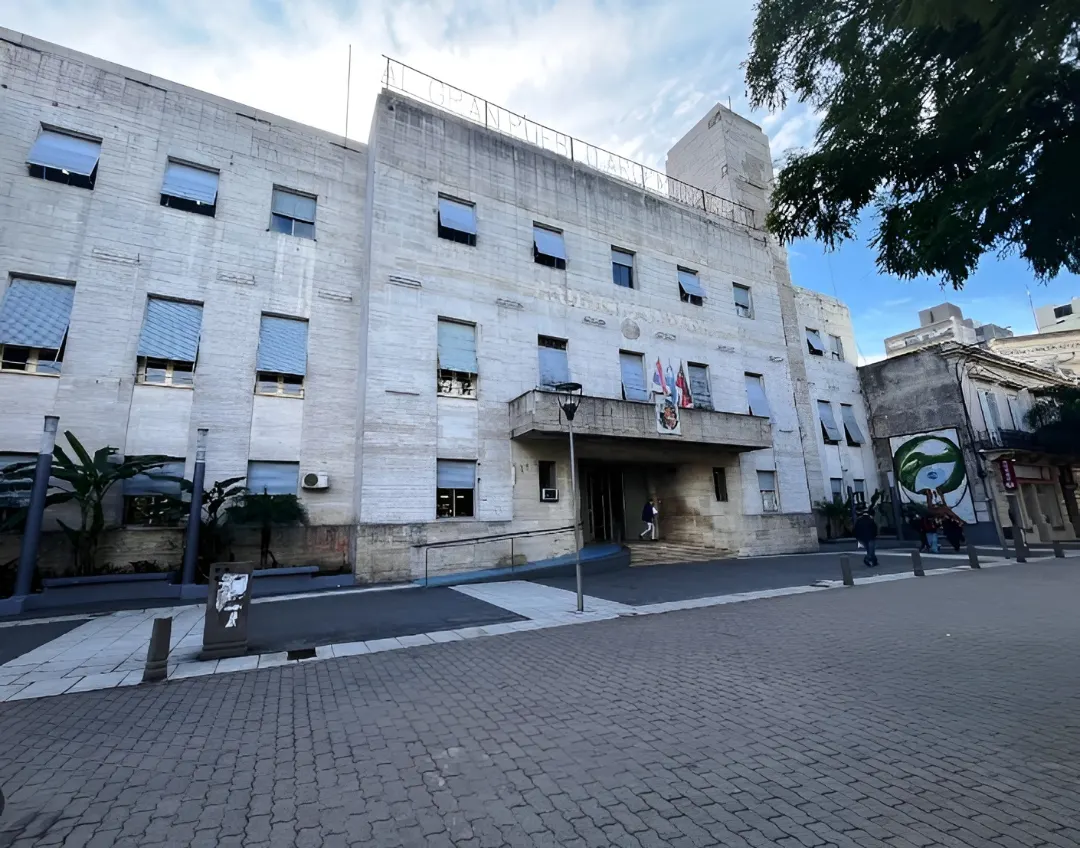
The ceremony, presided over by Mayor Francisco Azcué, was attended by Vice Mayor Magdalena Reta de Urquiza; the General Secretary of the Mayor's Office, Lorena Aguilar; Air Force Chief Corporal Miguel Ángel Thea; representatives of the Armed Forces and Security forces, councilors, and municipal officials.
Referring to the date commemorated this Thursday, Mayor Francisco Azcué stated that there are many residents of Concordia who have dedicated their lives to building the nation, to giving their lives for sovereignty in Antarctica, and we find it very important to honor and pay tribute to them.
“It is a moment in our history where we must appeal to patriotism to move our country and our province forward, and for our city to stand tall. Today more than ever, we need to shed any personal interest and show the community that we are public servants, and that is what we find in our Armed Forces, in the Security Forces, and in these patriots who give their lives to serve. It is an honor to have among us people who were in Antarctica, who are an example. And we want to precisely show those examples and infect our population with patriotic sentiment and a vocation for service; since they represent and promote all the values we need to move forward,” remarked Azcué.
During the ceremony, the General Secretary of the Mayor's Office, Lorena Aguilar, had emotional words to describe what the families of those who serve in the different bases experience, as her father, Félix Rubén Aguilar, participated in several campaigns in Antarctica. “From then on, he fell deeply in love with Antarctica, and that is why his ashes rest there.”
“During my father's first campaign to the white desert, I was a baby, and when he returned to the continent, I already knew how to walk and talk. Paola Pesce, who accompanies me today, was also very young; she was my age, but she spent it on the continent with her mother, being one of the first civilians to live with their families there. For this reason, for us who are daughters of those who have built the nation in Antarctica, this date is very special. Because we understand the value of defending sovereignty every day, raising our flag, educating their children, and researching the alternatives for life every day in a totally hostile environment, with temperatures exceeding 20, 30, and sometimes 50 degrees below zero. When we do not have our parents but we know they have made history, our chests swell with pride and we want to commemorate these dates. More than a century of exercising sovereignty by these men and women on the White Continent is what marks our identity as Argentines. I want to thank our mayor because it is the first time that this date is commemorated in Concordia with a formal act.”
For his part, Miguel Thea, who served on the continent, pointed out that “the truth is it is a pleasure to have this recognition. To recognize all those who have passed through and those who are today at this moment fulfilling duties in the white desert. For me, it is my place in the world. Having arrived at such an inhospitable place at just 27 years old was the destiny that marked my life, and this remains represented in a phrase that we Antarcticans say: 'when you arrived I did not know you, and when you leave you will take me with you.' Going to Antarctica is giving one's life to the homeland, exercising sovereignty in every sense. This is also a special moment to recognize the family that remains here on the Continent for a year or a little more. I would like to return; it is a dream to step on Antarctic soil again.”
120 YEARS OF PERMANENCE
Our country is the first to inhabit Antarctica uninterruptedly for 120 years with personnel from the Armed Forces, scientists, park rangers, and families. Being the country with the most bases: Orcadas, Carlini, Esperanza, San Martín, Belgrano II, Marambio, Petrel (permanent bases). Brown, Cámara, Melchior, Decepción, Primavera, and Matienzo, which are the temporary ones during the summer. The first Argentine to live in Antarctica was the native of Entre Ríos, Second Lieutenant Sobral, while another provincial, General Pujato, was the precursor in Antarctic exploration and founded three bases.
PRESENCES
Participating in the act were provincial deputy Liliana Salinas; the Chief of the 6th Tank Regiment Blandengues, Lieutenant Colonel Jorge Andrés Camerino; the Secretary of Institutional Development Cristian Federik; the Secretary of Productive Development Federico Schattenhofer; the Undersecretary of Culture Jorge García; the Director of Education Carlos Gatto; and council members Eliana Lagraña, Celeste Fuscado, Verónica del Boca, Mauricio Rey, Emmanuel Godoy, Claudia Villalba, Javier Aguilar, and Yahiza Pessolani.
Representing the Argentine Navy, Concordia Naval delegation, Sergeant Major Claudio Grandoli; the sub-officer in charge of the Argentine Navy, First Petty Officer of the Marine Corps Leonardo Gerard; Chief of the Concordia Prefecture, Prefect Jorge Ribinski; Chief of the Salto Grande Dam Prefecture, Prefect Andrés Aguirre; representing the Gendarmerie Squadron IV, Second Lieutenant Jesús Farján; Chief of the Entre Ríos Police Concordia Department, Commissioner Miguel Retamar; Director of Penal Unit No. 3, Jorge Vera, and members of the Armed Forces who were based in the Argentine Antarctica.