
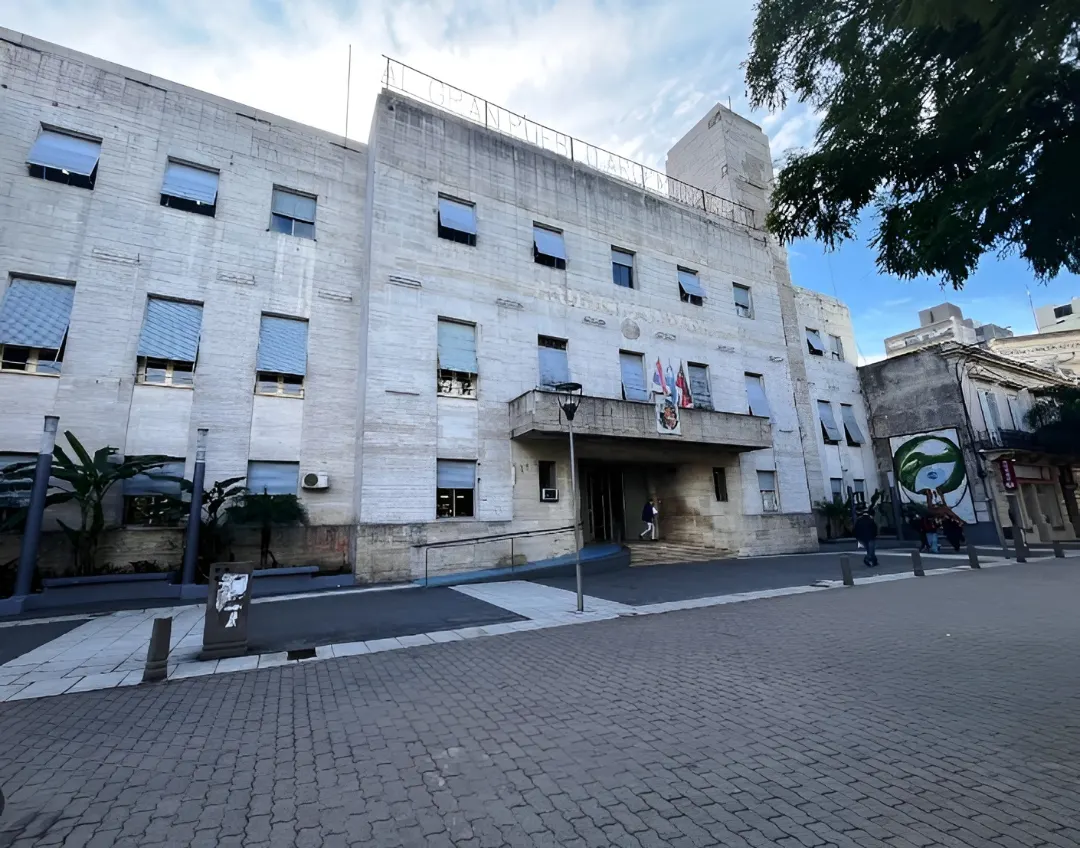
The SIMES (Comprehensive Municipal Health Emergency Service) is unique in its characteristics as it covers the 19 Municipal Health Centers and emergencies in municipal buildings, as well as sports and cultural events organized and supported by the Municipality of Concordia. It also acts as a collaborative effector on public roads with the Provincial 107 System.
MANAGEMENT DECISION
“There is a political decision here by mayor Enrique Cresto. Concordia is the only Department in the province that has 19 Health Centers and a Municipal Emergency System. We have been given the opportunity to grow in terms of supplies and personnel. I am convinced that we have a Municipal Emergency System that is a model in Entre Ríos,” stated Dr. Diego Sauré, Undersecretary of Health and medical director of SIMES.
In this regard, it should be noted that the current municipal administration incorporated the following:
- Sanitary tent (with 2 high-complexity therapy beds to assist in multiple accidents, floods, forest fires, natural disasters, and mass events)
- Medium-complexity ambulance (acquired with own funds)
- Electric Emergency Unit.
- Contingency response unit (Chevrolet S10 which, if necessary, is placed next to the tent with all the equipment.
- Nursing professionals were incorporated.
- Incorporation of state-of-the-art equipment such as ventilators and cardiac monitors.
-Management of ambulance acquisition from the Nation.
The entire city is covered by SIMES thanks to the bases located in 5 strategic points: South Post (located in Villa Adela and covering said neighborhood, as well as Benito Legerén, El Martillo, Las Tejas, old El Martillo and the section of Route 14 of closest influence), North Post (located in the Magnasco Health Center, which also covers Villa Zorraquín), Center Post, Post in Green Zone (it is on the city's Costanera with coverage throughout the Campo de los Deportes, Costanera and Health Centers: Nebel, Barrio Nebel, San Agustín, and Río Uruguay Park) and Post in the Perilago/Airport area.
“Each post has an area of influence and its mission is, if an emergency occurs, to collaborate with the 107 when they call us and provide an almost immediate response, shortening arrival times, with units that go with a sanitary driver and a nurse/technician. The same happens when we intervene directly because the situation scenario determines it,” explained Sauré in this regard.
A BASE AT THE NEW AIRPORT
It is worth noting here the role of the Perilago/Airport base, whose characteristic is that, in addition to providing health coverage to its area of influence, it serves the numerous construction personnel of the New Airport, the Border Crossing and the Perilago. It is located within the premises. It is a sanitary bus that has a first aid room suitable for care.
“We, together with mayor Cresto, have the idea that this area should be protected by the Municipal Health System. In addition, we take advantage of the place where we have a base with an ambulance that operates from 6 in the morning until 10 at night to cover all the surrounding areas that correspond to National Route A015, Villa Zorraquín, Osvaldo Magnasco and Monseñor Rösch Avenue where there is a high incidence of traumatic events,” the Undersecretary of Health expanded on the matter.
Leonela is a nurse and works at the Villa Adela post, where she covers 12-hour shifts. “What we do is emergency, scheduled transfers. We do a little bit of everything. We are a work trio,” she described; while Jésica, another nurse, said from the base in the Green Zone: “I am in charge of the entire pre-hospital part of mobile unit 15, going to homes, doing the first care for users and the first attention that each person requires.”
“MOBILE EMERGENCY HOSPITAL”
Diego Ábalos, coordinator of SIMES, explained about another key element that was acquired during the Cresto mayoralty: “The tent, together with our truck, are a contingency unit. We have a sanitary tent for sports, social and cultural events. It intervenes when there is one with massive attendance in order to avoid saturating the entrance to hospital emergency rooms,” he commented.
Specifically, it is an inflatable tent 6 meters wide by 6 meters long with capacity for 2 shock room beds: for critical patients (it has 2 cardiodefibrillator monitors, oxygenation equipment and an automatic ventilator), and 8 beds for non-critical patients. It is totally autonomous since it has its own power generator, and is fully climate-controlled.
In addition, together with the tent, for mass events, the Electric Emergency Unit (U.E.E.) and the Versatile Electric Unit in mobility are incorporated, within the public for patient extraction. “The advantage it gives us is being able to attend, stabilize and evaluate patients on the spot and only transfer those who, due to their condition, require it and thus avoid collapsing hospital emergency rooms,” they expanded from the Health Secretariat.
The tent was fundamental at the La Renga concert, at the Campo de los Deportes, where 300 patients were treated and stabilized on the spot. Only 4 transfers were referred to the “Delicia Concepción Masvernat” hospital. Other mass events covered by SIMES were the Citriculture Festival (40,000 people), the Kings Marathons, the carnivals (more than 120 people were assisted on site) and even the health coverage of the TC 2000, Turismo Carretera and Procar 4000 was carried out, all at the “Ciudad de Concordia” Autodrome Park.
In summary:
· SIMES not only covers municipal spaces such as the 19 Health Centers, a unique number in the province, and municipal buildings; but also, thanks to the support of mayor Enrique Cresto, it collaborates with the 107 Service, which is the legal provider for public roads.
· To improve the Service, more resources were incorporated such as the Sanitary Tent, the Electric Emergency Unit, state-of-the-art equipment and a medium-complexity ambulance acquired with own funds; and nursing professionals were also incorporated.
· Thus, Concordia has 5 posts strategically located throughout the city that, in connection with a base located in the Health Secretariat, responds to emergencies that arrive at the Provincial 107 Service, thus decompressing the emergencies and the care provided in public hospitals.