
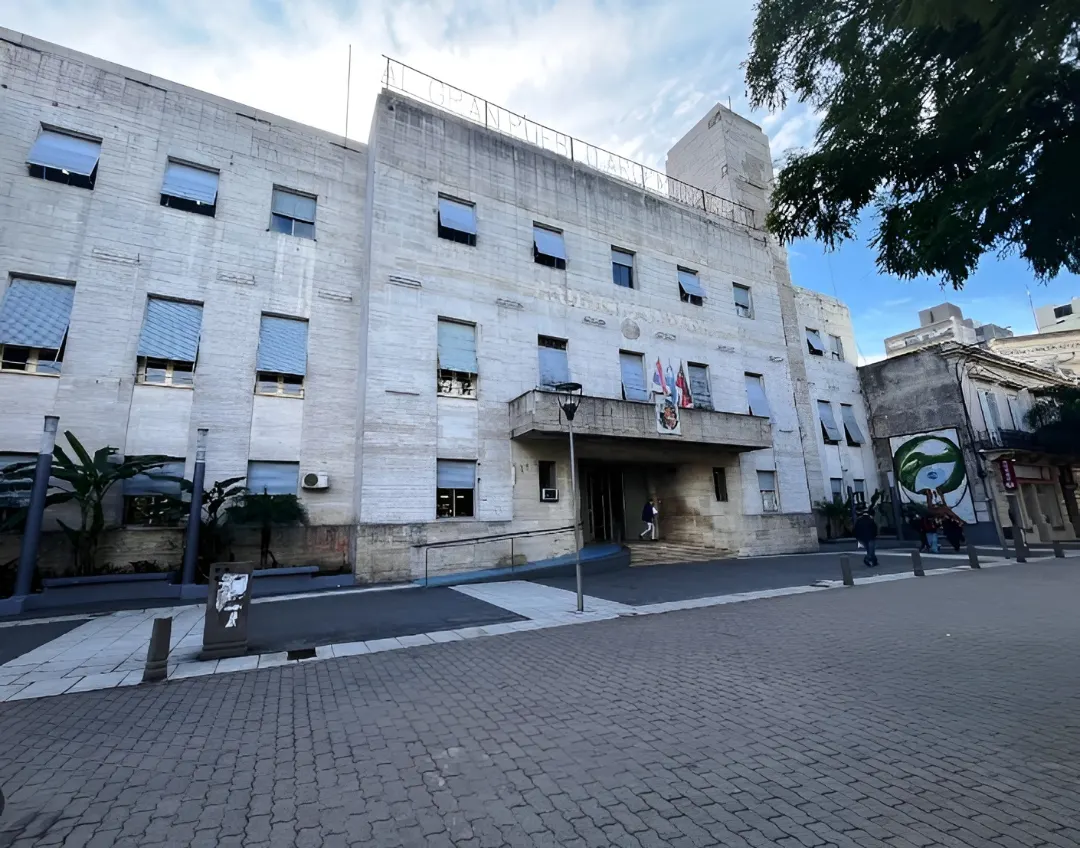
This Monday morning, the Decentralized Sanitary Works Entity (EDOS) began work on a new borehole that will benefit the Delicia Concepción Masvernat Hospital and, indirectly, the neighborhoods in the area once the supply is redirected. The tasks are being carried out with personnel and resources from the Municipality of Concordia and the Entity itself.
This work arises from the need to respond to the daily demand of the hospital, whose supply is complicated by the weather conditions that affect the city in the summer, in addition to being the main hospital on the Uruguay River coast, serving an important sector of this region of the province.
William Sosa, Operations Manager of EDOS, indicated that the objective “is to provide a definitive solution to the supply problem for the hospital, which also has an elevated cistern tank, making it difficult for water to reach it during times like these of low pressure.”
After pointing out that the work is being carried out exclusively with both municipal and Entity funds and personnel, Williams reported that this first stage will take approximately 3 to 5 days.
COMPLEMENTARY WORKS
Once the drilling is completed, the complementary works will be carried out, which include making the connection with the entire conduit to the hospital.
Meanwhile, “the corresponding water analysis studies will be carried out, which will be “more exhaustive than conventional ones, since we are not only going to perform physical-chemical and microbiological studies, but we will also be conducting analyses for pesticides, herbicides, and a profile of hydrocarbons and solvents.”
Once these studies are carried out, confirming that the water is in optimal conditions, “we will proceed to make the connection,” noted the EDOS Operations Manager.
CONSUMPTION
Finally, Sosa clarified that this borehole is exclusively for the Masvernat hospital, as it is currently consuming at a rate of 16 cubic meters per hour, “which is a considerable flow equivalent to what an entire neighborhood would consume.”
In any case, he indicated that this work will indirectly benefit the neighborhoods in the area once the supply is redirected.