
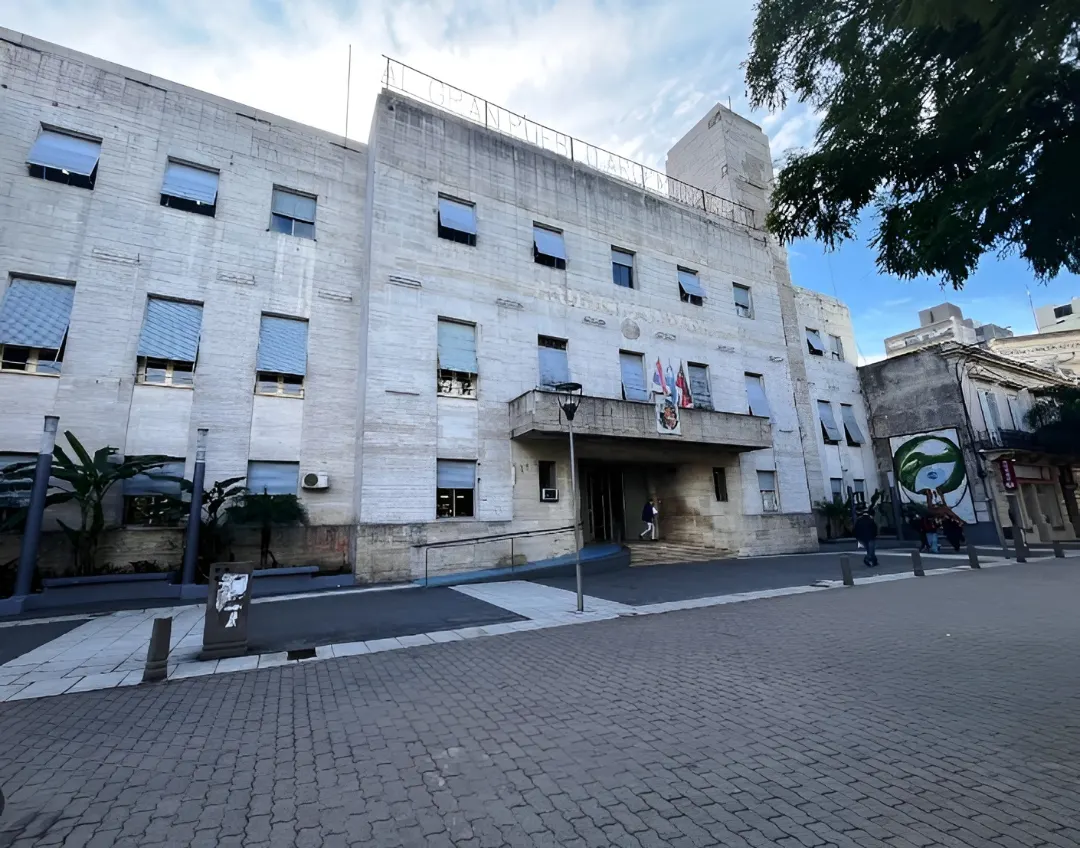
In his speech, Mayor Francisco Azcué emphasized the situation in which he found the Municipality of Concordia at the beginning of his administration, which is nearing its first 90 days, but he also outlined the policy guidelines to be developed during the current year.
“When I decided to join this political project led by Rogelio Frigerio, I knew very well what I was exposing myself to, which city I had to manage, and what measures to take. With the team that accompanies me, we had a diagnosis that has been confirmed in these few weeks of government,” Azcué began by pointing out.
In these 40 years of democracy, “Concordia has lost relative importance, losing the productive dynamic that at some point characterized it, and as a consequence of this, it is unattractive for new economic investments or the expansion of existing ones. Concordia is not a poor city, it is an impoverished city,” he emphasized.
Achieving a change in this reality “is not a simple task because when we get used to something working poorly, we normalize it and even make it our own; that is why our effort will be to try to be better and accept the challenge of assuming the share of commitment that corresponds to each one of us.”
“BANKRUPT MUNICIPALITY”
After listing the various complex realities that the current administration encountered in terms of economy, infrastructure, and equipment, Azcué stressed that “we inherited a very complex financial situation and I want to be clear: they handed us a bankrupt Municipality,” remarked Azcué.
This situation was aggravated in the first days of government due to the strong recession that impacted the decline in tax collection. “Revenues fell drastically, which forced us to carry out a cut in public spending, in line with what President Javier Milei and the provincial governor asked of us.”
Currently, “an efficient management of public spending is allowing us to overcome the crisis left by Alberto Fernández and Sergio Massa, which destroyed the value of the peso and unleashed uncontrolled inflation.”
OBJECTIVES AND PROJECTS
Regarding the objectives and projects to be achieved in the current year, the Mayor announced that work will be done on a new Municipal Organic Charter oriented “to the real needs of the city,” noting that he has entrusted the Vice-Mayor and the Secretaries with “a complete restructuring of the areas under their charge, reducing the political staff and providing it with greater efficiency that allows solving the priorities that the city presents.”
The other point is the holding of internal competitions “that allow for the professionalization and training of the municipal family, a fundamental link in this chain that will allow for a better response when it comes to managing public affairs.”
“We are going to develop a transparency plan that includes control over the evolution of the assets of officials and the publication of all official contracts,” and just as he requested all officials to submit their sworn statements and criminal record certificates, “I have asked the councilors to make the mandate of the Municipalities Law a reality for the creation of an internal audit, of a permanent nature, that controls all acts of government.”
Regarding security, he made it clear that all necessary resources will be put in place to be able to return tranquility to the families of Concordia, which in most cases is due to the growth of drug trafficking and those who destroy the lives of many young people, “whom we declare our enemies.”
TAX REFORM, SOCIAL AID, AND DECENTRALIZATION
Another objective to work on this year is the comprehensive reform of the Tax Ordinance. “We want to modernize and simplify the municipal taxes, a project that we invite all the blocks of the Deliberative Council to debate and support.”
A new social aid scheme will be implemented in the current administration “because we are convinced that aid must reach the citizens who need it directly, ending a business for a few, who withdrew food but did not cook. This administration wants to stop being a headline in the national media every time poverty indices are known.”
A program will be implemented to facilitate access to housing and territorial planning, which includes, among other policies, improvements to housing and the surroundings of popular neighborhoods.
Municipal decentralization, started this week in Villa Adela, will be deepened to bring the Municipal State closer to the residents “so that they do not have to go to the Municipality and can carry out their procedures near their homes.”
TOURISM AND ENVIRONMENT
Strengthening tourism entrepreneurs is another objective to be met “to generate genuine and quality employment, with the presence of the State, ceasing to be a machine of obstruction to become a machine of facilitation. Conditions must be generated so that the private sector can continue to develop freely, and for that, we want to modify the Urban Code.”
The enhancement of the Naranjal de Pereda, within a comprehensive plan with the Parque San Carlos and the historical buildings “that show us how great Concordia used to be and that it will soon shine again.”
Azcué stated that it is fundamental to start as soon as possible with a sewage treatment plant. “We know it is an ambitious project, but we have been talking with provincial authorities to obtain financing.”
Caring for the environment is related to the separation of waste at the source, a system that will soon be implemented throughout the city to achieve greater efficiency at the Campo El Abasto Treatment Plant.
In closing his speech, Mayor Francisco Azcué spoke to the Concordia community, remarking that “I did not come to public management to seek fame, but rather you have chosen me to lead a transformation that goes from the inside out; we will go through this process looking each other in the eye. I know the road is long, but I am moved by an infinite love for my city; thank you for the support, and I know that day by day we will fulfill the dream of Concordia becoming a land of progress again.”