
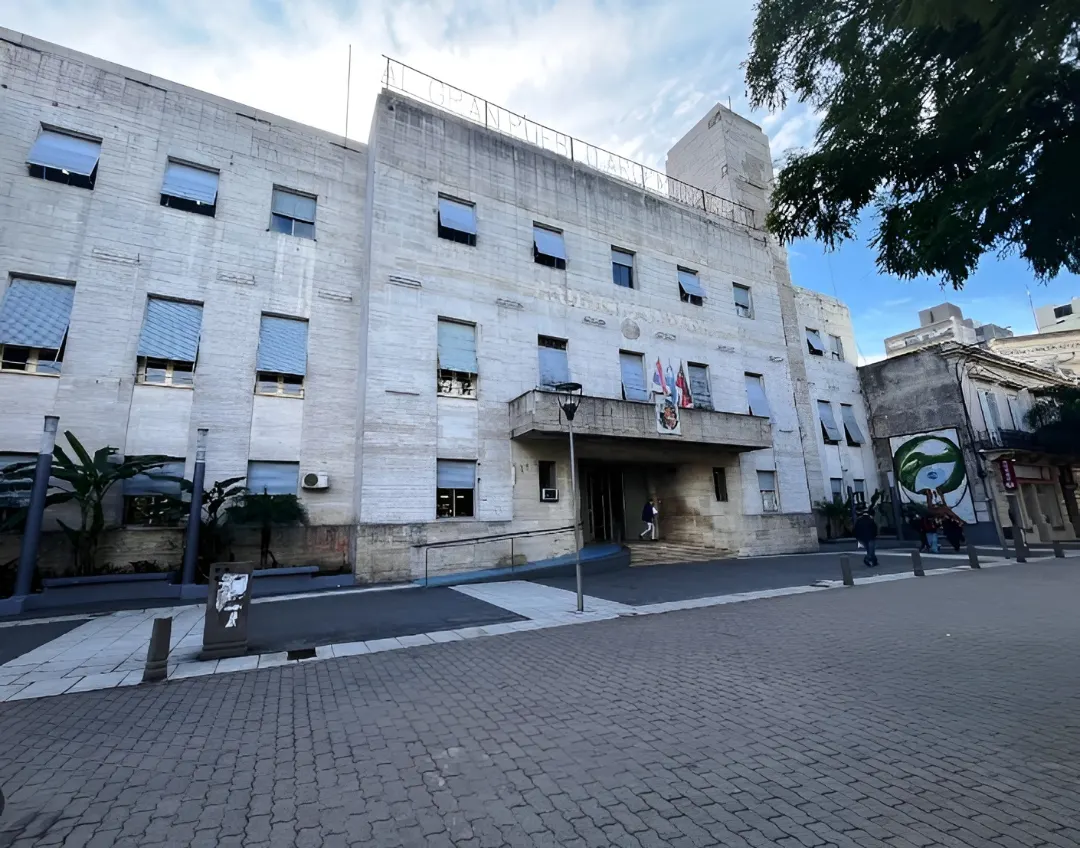
On Friday morning, Mayor Francisco Azcué received, from the hands of the President of the Argentine Delegation to the Mixed Technical Commission of Salto Grande (CTM), Amb. Alejandro Daneri, the donation of automated external defibrillators (AED). The Departmental Police Headquarters, the Volunteer Fire Department, and the Felipe Heras Hospital also received them.
The initiative allows for the strengthening of the “Protected City” program, which is promoted by the municipality and aims to reduce response times to emergencies and save lives by adding CPR training and the strategic distribution of AEDs in Concordia.
EMERGENCY RESPONSE
Mayor Azcué, after thanking for the donation and announcing that the defibrillators will be used in Health Centers and various municipal offices, remarked that this is an action that is the result of work between the Municipality and the different agencies and institutions of the city and the province.
“It is the path marked by Governor Rogelio Frigerio, that of working as a team because when this is achieved, the results and the efficiency of the management are visible,” he remarked.
What was received this Friday “we are going to use for the most important thing we have in Concordia, which are our residents who, when they have an emergency, are not thinking about whether it is the responsibility of the Municipality or the Province, but rather they need a response, and that is our way of working.”
JOINT WORK
Ambassador Daneri highlighted that the initiative, promoted by the Argentine Delegation, contributes 22 defibrillators to Concordia, in order to promote the city as a cardio-assisted area.
“We are pleased to be able to carry out this donation, which undoubtedly means the possibility of saving lives in critical moments,” expressed the President of the Argentine Delegation.
OPERATIONAL CAPACITY
Finally, the Municipal Secretary of Health, Dr. Diego Sauré, pointed out that AEDs have a very significant cost, which is why he highlighted and underscored the importance of the action, announcing that in the coming months, Concordia will adhere by ordinance to the National Sudden Death Law, legislation that “requires having these automated defibrillators available to act in the event of cardiac arrest.”
By way of information, Sauré stated that “80% of cardiac arrests occur in private homes and the possibility of survival drops by 10% for every minute, which means that one must arrive early, with trained personnel and adequate equipment,” therefore, he reiterated, the significance that these received AEDs acquire.
Present were National Deputy Nancy Ballejos; the Vice Mayor and President of the Deliberative Council Magdalena Reta de Urquiza; the Vice President of CTM Pedro Galimberti and delegate Juan Carlos Chagas; the Director of the Felipe Heras Hospital Exequiel Ortíz; the head of the Departmental Police Headquarters Commissioner José María Rosatelli; the President of the Volunteer Firefighters Association Oscar Arce, the Chief of the Concordia Volunteer Firefighters Cristian Bravo, and council members.