
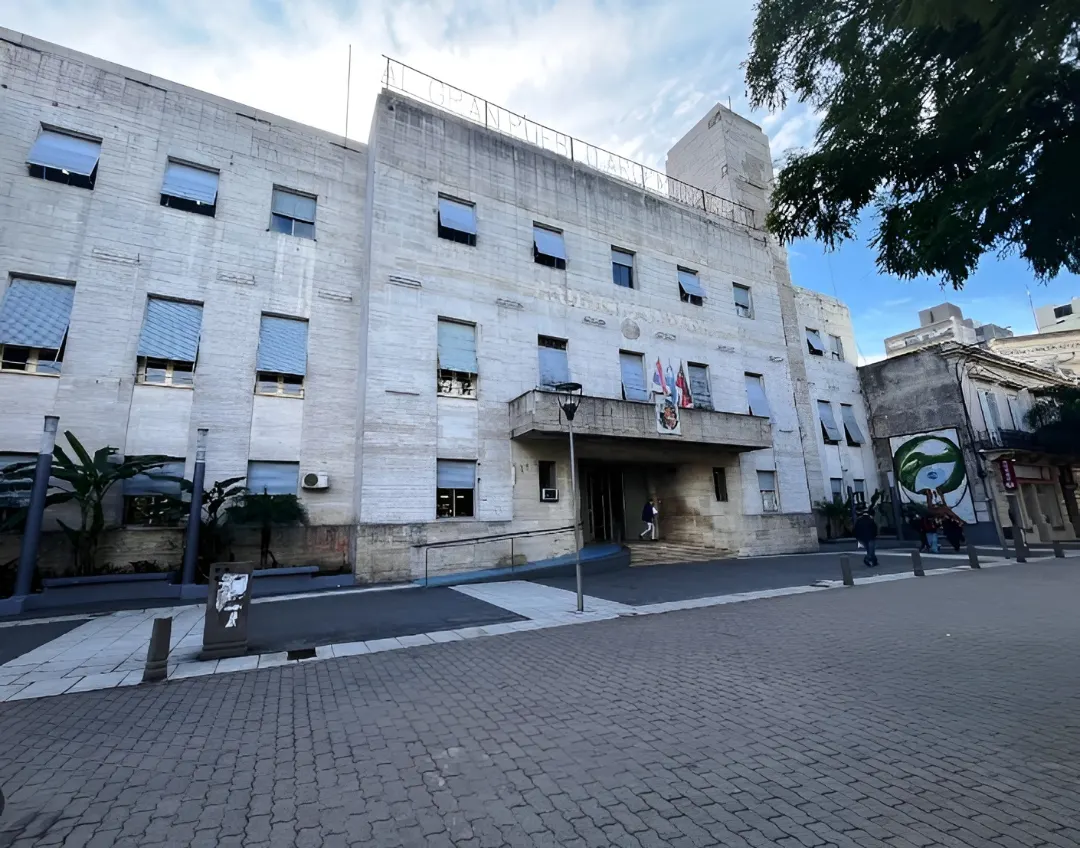
During this Monday morning, mayor Francisco Azcué toured the new housing units that are close to being delivered in the Agua Patito neighborhood. The initiative is part of the “Revitalization of the Northwest Zone” Project, carried out by the Municipal Autonomous Housing and Land Institute (INVyTAM).
The progress of the project seeks to resolve access to the city for families located in areas with structural and environmental risks that are impossible to formalize.
The action promotes the socio-urban integration of the northwest area of the city. It includes the development, improvement, and allocation of functional units for families in housing emergency situations, settled on informal and flood-prone land.
To this end, work is contemplated on educational, health, environmental, cultural, and economic variables that will decisively imply the coordinated and strategic interaction of various areas of the Municipality.
Such interaction is a condition of possibility to consolidate the rooting of families in the sector and guarantee the general development of said urban area.
PROCESS
After his tour, Azcué indicated that in this first stage, 9 homes were built, marking the beginning of a process that aims to relocate families that fall within the studies carried out prior to the selection.
The mayor pointed out that in the Agua Patito neighborhood “there was a housing project that failed, since previous administrations never built them, but we, with municipal resources, have started to build again in this sector of the city”.
Azcué remarked that the arrival of the families to their homes is the final step of work carried out previously: “it is not just that we bring the family and leave them living here. All year we worked on a process of rooting, where we got school spots for the children, the families came to see their houses, and medical records were already brought here to the nearest Health Centers” among other actions.
Regarding the housing units themselves, he highlighted the quality and the materials used: “We have permanently followed the construction process, generating this model. We will continue working and investing resources in this program” highlighted Azcué.
INTEGRATE AND REVITALIZE
For his part, Giuliano Rossi, president of the Municipal Autonomous Housing and Land Institute (INVyTAM), specified that the objective is to advance in socio-urban integration, that is, “an idea of habitat development, deploying multiple variables that translate into activities linked to sports, the environment, culture, social aspects, and the work that contributes to the well-being of families and the development of the community”.
These 9 homes will house in a few days “families that are in a socio-environmental emergency situation; in this case, these are families that are flooded. What comes next will be to advance with families that are in other situations that we call impossible to formalize,” pointed out Rossi.
SELECTION CRITERIA
Manuela Pelizzari, director of the Community Area of the INVyTAM, detailed that the selection criteria for the nine family groups were mainly related to the fact that they live in a flood-prone area, the length of stay in those areas, family composition, having risk situations such as disability, minor children or elderly people, not having been beneficiaries of any other program previously, and not having a criminal record.
Finally, Mauricio Perdomo, director of Works and Projects of the INVyTAM, explained that the choice of the Agua Patito neighborhood is related to the “presence of infrastructure that we had from previous processes, in which the construction of housing was left unfinished”.
With a change of system, he detailed that “the goal was to generate housing units that have two bedrooms, a bathroom, a kitchen, drywall partitions, and an integrated dining room.”